
How to Choose the Best Covered and All-Season Backyard Pool Enclosures
Backyard Pool Enclosures Make Outdoor Living Easier
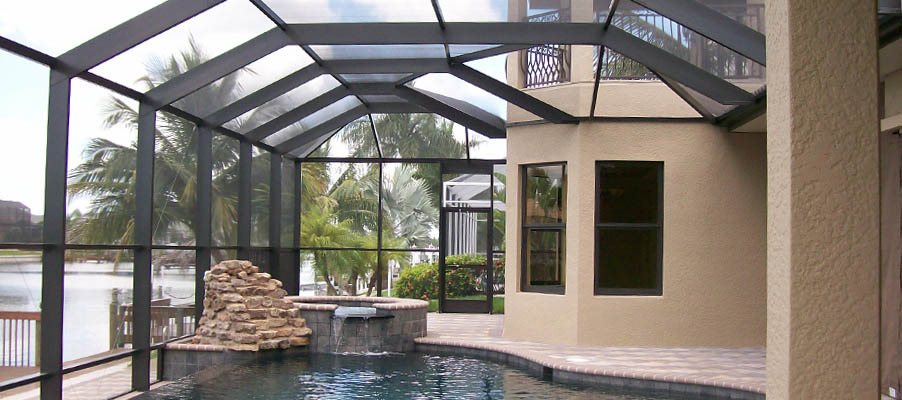
Backyard pool enclosures create a cleaner, more comfortable, and more protected pool area by keeping out insects and debris while adding shade, safety, and weather coverage. The best choice depends on whether you want an open-air screened space, a solid all-season structure, or a retractable design that can do both.
| What homeowners want | Pool enclosure feature to explore |
|---|---|
| Fewer bugs, leaves, and cleaning tasks | Aluminum screen enclosure |
| More shade and UV protection | Screened roof or covered pool structure |
| Longer swimming season and heat retention | Polycarbonate or glass-panel enclosure |
| A safer barrier around the pool | Lockable doors and code-aware access points |
| Open-air use on sunny days | Retractable or telescopic enclosure |
For Fort Myers and Cape Coral homes, the right enclosure also needs to suit the pool deck, yard layout, ventilation needs, and local wind-load requirements. A well-planned aluminum enclosure can protect the pool area without making the backyard feel closed in.
I am Sherman Walker, owner of Aluminum Concepts Construction, Inc., with nearly 25 years of residential construction and home-improvement experience in Southwest Florida. My work with backyard pool enclosures and custom aluminum structures helps homeowners create durable outdoor spaces that are easier to enjoy and maintain.
Core Benefits of Backyard Pool Enclosures
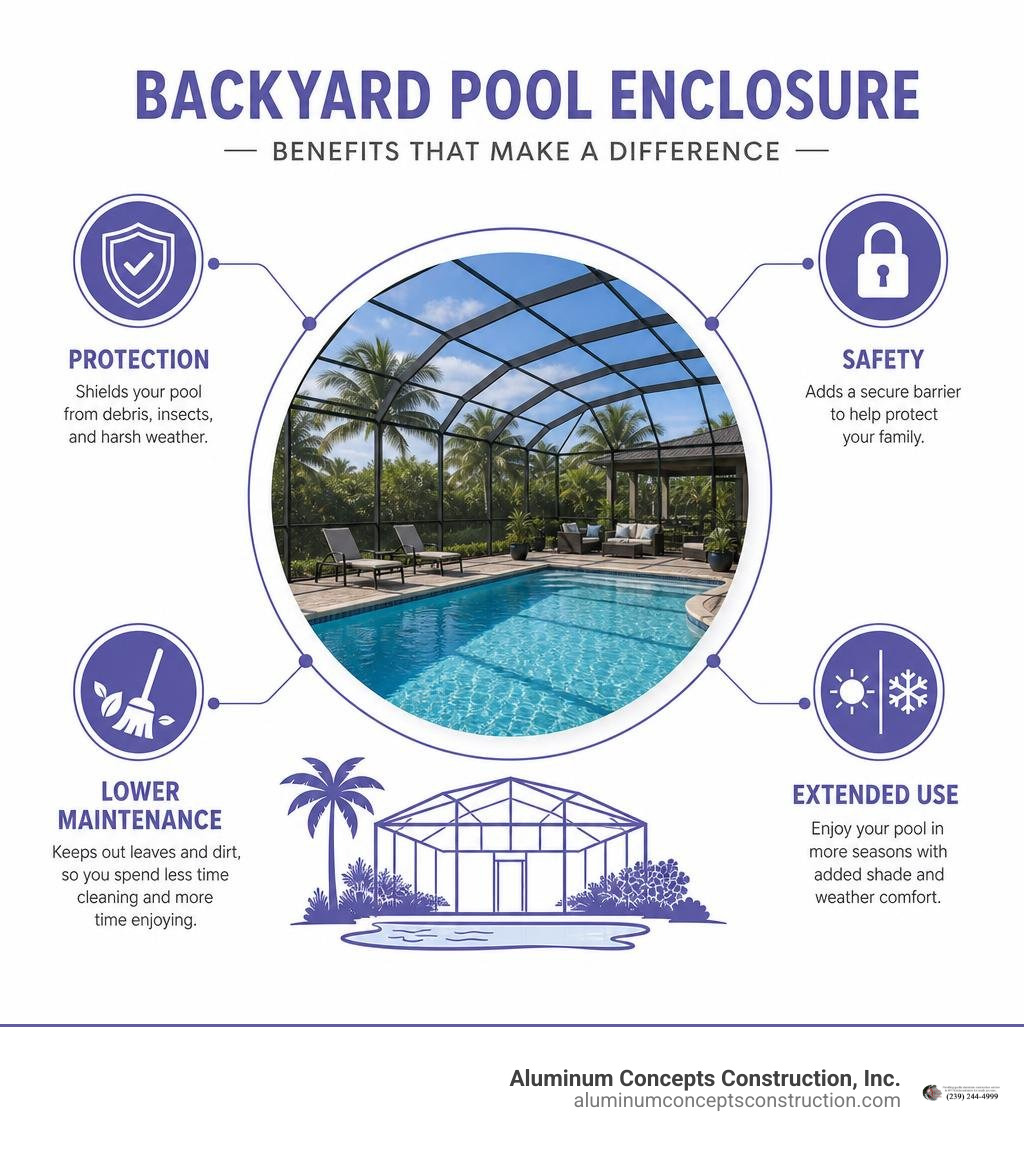
Installing backyard pool enclosures transforms an open-air swimming pool into a private, low-maintenance retreat. In coastal environments like Fort Myers, Cape Coral, and Sanibel, direct exposure to relentless solar radiation, summer downpours, and neighborhood pests can make managing an open pool feel like a second job. Enclosing the area resolves these daily challenges while boosting the overall functionality of your outdoor living space.
First, enclosures provide an extended swimming season and enhanced climate stability. While Southwest Florida enjoys warm temperatures year-round, sudden cloud cover, cool evening breezes, or winter dips can chill pool water rapidly. Enclosures with solid polycarbonate roofing or thermal-retaining panels trap ambient heat, functioning like a passive greenhouse to keep pool temperatures comfortable for 9 to 12 months a year without skyrocketing your electric bill.
Second, shielding your pool drastically reduces chemical degradation and evaporation. Ultra-violet (UV) rays breakdown chlorine rapidly, forcing homeowners to constantly replenish costly water treatments. By cutting down direct UV radiation and blocking rainwater diluted with airborne pollutants, an enclosure stabilizes water chemistry.
Third, the reduction in physical maintenance is immediate. Grass clippings, palm fronds, seed pods, and pine needles from nearby foliage are stopped cold before hitting the surface. Skimmers and pumps operate efficiently without getting clogged by organic debris, which protects expensive filtration components from premature burnouts.
Safety and Child Protection in Backyard Pool Enclosures
Beyond cleanliness and climate benefits, backyard pool enclosures act as essential structural safety barriers. For households with young children, visiting grandchildren, or pets, an open water feature presents a continuous hazard.
A high-quality aluminum cage or rigid enclosure integrates lockable safety doors, self-closing latches, and tamper-resistant entryways that physically separate the pool from surrounding yard space. This structural security helps meet rigorous municipal safety codes in Lee County while providing complete peace of mind. Additionally, closed structures keep out regional wildlife—including mosquitoes, wasps, frogs, and snakes—ensuring every swim remains peaceful and safe. To explore various custom enclosure options, check out our insights on Pool Cages to see how structural design integrates seamlessly with home safety.
Key Types and Designs of Backyard Pool Enclosures
Selecting the ideal design comes down to how you plan to use your pool, your aesthetic preferences, and the specific footprint of your deck. Today’s structural engineering allows for a diverse range of configurations, from fixed aluminum screen rooms to dynamic telescopic systems.
Popular design formats include:
- Fixed Screen Enclosures: The classic Florida standard, featuring heavy-duty extruded aluminum frames paired with durable mesh screening to maximize airflow while blocking bugs and debris.
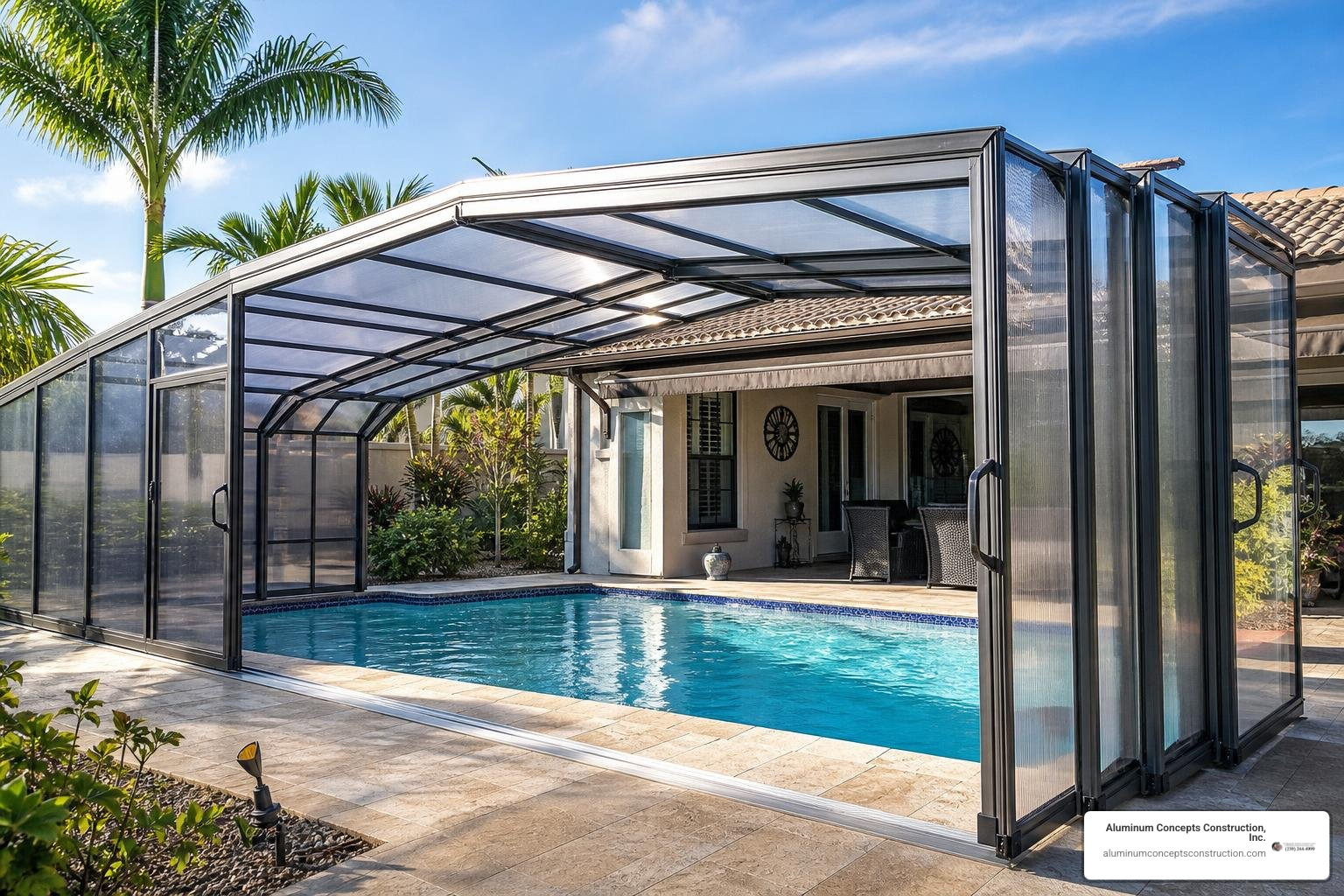
- Retractable and Telescopic Structures: Modular segments mounted on ground tracks that slide open or closed. Modern models, such as the NEO – Telescopic pool enclosure – AZENCO – Miami , feature nested panel design options and optional solar-powered motorization to open or cover the pool in minutes.
- House-Attached Enclosures: Structures attached directly to your home’s fascia or roofline, effectively extending your indoor living room directly onto the pool deck.
- Standalone Enclosures: Free-standing structures situated completely independent of the main dwelling, ideal for detached pool decks, swim spas, or expansive rural properties in areas like North Fort Myers and Pine Island.
Low-Profile vs High-Wall Retractable Designs for Backyard Pool Enclosures
When considering retractable backyard pool enclosures, homeowners generally choose between low-profile and high-wall structures depending on sightline preferences and interior space requirements.
Low-profile enclosures sit sleekly above the deck, often keeping beneath stockade fence heights to preserve wide-open, unobstructed view corridors across your landscape. While you can comfortably swim inside a closed low-profile enclosure, headroom is restricted to the water surface; standing up on the dry deck requires retracting the sliding segments back along extended tracks behind the pool.
High-wall structures—such as standard high-arched models like the Standard Swim Spa & Pool Enclosure – Laguna Type I | Pool & Spa Enclosures —provide full standing clearance throughout the entire enclosed space. High-wall units allow you to place patio furniture, loungers, and tropical plants under cover, effectively creating an all-season sunroom around your water feature.
Screen Enclosures vs Polycarbonate and Glass Structures
Choosing between screen mesh and solid paneling dictates your pool’s interior environment:
- Screen Mesh Enclosures: Provide optimal natural airflow, keeping the pool area breezy and fresh while providing partial shade (typically blocking 30% to 70% of solar heat depending on screen density). They are the top choice for homeowners who love open-air swimming without insect intrusion. Explore our options for Fort Myers Screened Rooms to learn how screening enhances outdoor living spaces.
- Polycarbonate Paneling: Employs twin-wall translucent or clear polycarbonate panels that provide complete rain protection, superior thermal insulation, and total UV defense. These panels retain pool warmth during cool months and completely shut out humidity when closed.
- Glass Enclosures: Deliver crystal-clear visibility and structural permanence, though they carry higher structural weight and installation costs compared to lightweight aluminum and polycarbonate systems.
Material Comparison and Structural Engineering Considerations
The longevity of backyard pool enclosures in coastal environments hinges directly on material selection and structural framing details. High humidity, salt-laden air, and intense tropical heat require materials engineered to endure harsh weathering without degrading or oxidizing.
Extruded aluminum framing forms the core backbone of high-performance enclosures. When finished with thermoset architectural powder coating, aluminum resists corrosion, peeling, and chalking far better than painted or untreated metals. Fasteners, splines, and hardware must also consist of high-grade stainless steel or nylon-coated composites to prevent unsightly rust streaks and structural weakening over time.
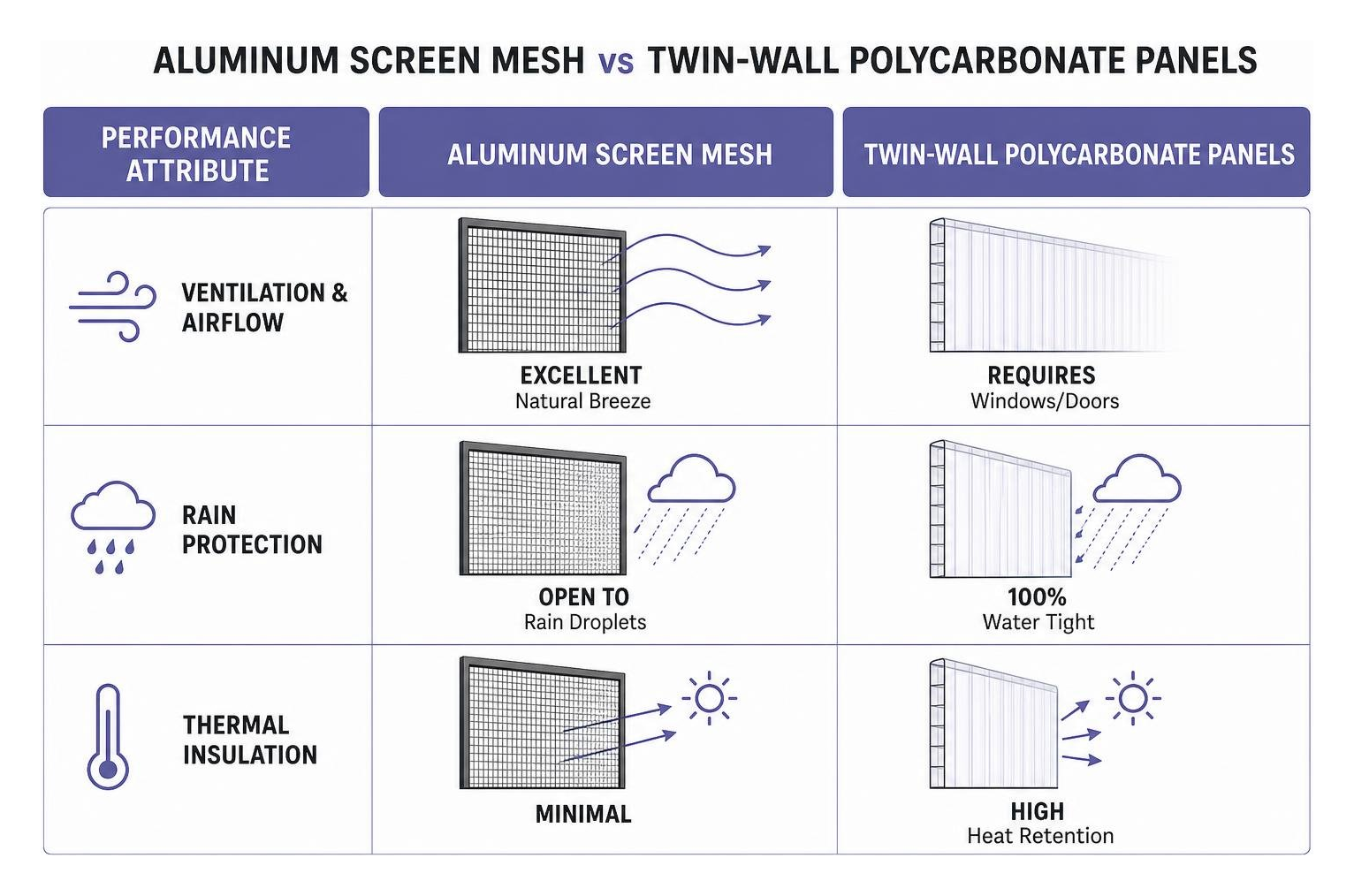
| Performance Attribute | Powder-Coated Aluminum Screen Mesh | Twin-Wall Polycarbonate Panels | Clear Tempered Safety Glass |
|---|---|---|---|
| Ventilation & Airflow | Excellent / Natural Breeze | Requires Windows/Doors | Requires Mechanical Vents |
| Rain Protection | Open to Rain Droplets | 100% Water Tight | 100% Water Tight |
| Thermal Insulation | Minimal | High Heat Retention | Moderate Heat Retention |
| Debris & Bug Defense | Complete Barrier | Complete Barrier | Complete Barrier |
| UV Protection | Partial (30%–70%) | High (Up to 99% UV Block) | Partial to High (Treated) |
| Maintenance Requirements | Periodic Washing / Rescreening | Frame Washing & Seal Checks | Frequent Glass Cleaning |
Wind Load Ratings and Storm Protection
In regions such as Fort Myers Beach, Bonita Springs, and Cape Coral, structural design is dictated by strict Florida Building Codes regarding wind resistance. Backyard structures must be engineered to withstand severe tropical storms and hurricane-force winds.
To ensure long-term durability:
- Frame Gauge and Engineering: Frame profiles are custom-sized and gusset-reinforced based on the span width and building height to meet local wind load specifications.
- Deck Anchoring: Heavy-duty concrete wedge anchors or stainless steel anchor bolts lock the base channels securely into structural concrete footings or reinforced deck foundations.
- Pressure Relief Features: Screen enclosures inherently allow high winds to pass through mesh pores, minimizing uplift and lateral drag. Solid polycarbonate and retractable systems use engineered locking pins and wind-rated track guides to secure individual segments against severe storm gusts.
For existing structures showing wear, routine upkeep or updating components is essential to maintain structural integrity. Check out our guide on Hurricane Proof Your Screened Enclosure to ensure your structural framing and screen tension are ready to face seasonal weather events. If your current screens are torn or loose, scheduling a Fort Myers Pool Rescreening restores full insect protection and wind resistance.
Cost, Permitting, and Installation Guidelines
The overall investment required for backyard pool enclosures varies based on overall footprint, structural material, site accessibility, and custom design additions.
Key factors shaping project scope and budget include:
- Permit Requirements: Every permanent structure installed in Lee County requires formal architectural drawings, wind-load calculation packets, and municipal building permits prior to site ground-breaking.
- Deck Preparation & Footings: Enclosures require a stable, level foundation. Standard concrete pool decks usually satisfy load requirements, but expansive structures or high-wall retractable systems may require concrete footings along perimeter anchor lines.
- Custom Adjustments: Roofline attachments, mansard roof shapes, custom door placements, or specialized entry features—like a dedicated Fort Myers Screening Front Entry—add functional elegance but require custom fabrication.
Standard vs Custom Enclosure Models
Homeowners often evaluate standard prefabricated structures against fully custom-engineered aluminum enclosures. Standard modular models come with predetermined dimensions, offering streamlined production timelines for straightforward pool footprints or swim spas.
Custom enclosures, by contrast, are built to match the unique footprint of your home’s rooflines, patio extensions, deck angles, and landscape contours. While custom fabrication requires extra initial design and field measurement work, the result is a seamless architectural fit that enhances your property’s resale value and curb appeal. Nearby civic facilities, such as the public amenities at Pine Island Community Pool , highlight how specialized, large-scale structures keep swimming areas protected and operational year-round.
Frequently Asked Questions about Pool Enclosures
Can you swim inside a low-profile pool enclosure when closed?
Yes, you can comfortably swim and exercise inside a low-profile pool enclosure while it is fully closed. Low-profile designs maintain clearance above the water surface to accommodate swimming strokes, water aerobics, and relaxing on floating loungers. However, standing upright on the dry pool deck requires sliding the telescopic segments back along their deck tracks to open the space.
How do pool enclosures withstand hurricane winds and weather?
Engineered aluminum enclosures withstand severe weather through heavy-gauge structural aluminum alloys, reinforced corner gussets, and stainless steel anchor systems driven directly into concrete foundations. Screen mesh panels allow wind pressure to vent directly through the material, preventing massive pressure buildup. For solid polycarbonate enclosures, panels are held in place by deep-channel locking tracks designed to resist specified wind load ratings according to local building codes.
How much maintenance do aluminum pool enclosures require?
Aluminum pool enclosures require minimal routine maintenance. Rinsing the aluminum frame and screens periodically with a garden hose and mild soapy water removes settled salt, pollen, and dirt. Sliding track mechanisms on retractable enclosures should be kept clear of sand and garden debris. Additionally, checking frame fasteners, door hinges, and panel splines annually ensures smooth operation and long-term durability.
Conclusion
Investing in high-quality backyard pool enclosures transforms your swimming pool into a low-maintenance, comfortable, and protected oasis. Whether your goal is blocking insect pests with breathable screen mesh, creating an all-season haven with thermal polycarbonate panels, or gaining flexibility with a retractable telescopic structure, choosing the right combination of materials and design ensures long-lasting performance.
At Aluminum Concepts Construction, Inc., we bring nearly 25 years of specialized expertise in custom aluminum design, pool cages, screen enclosures, and hurricane-ready construction to homeowners across Fort Myers, Cape Coral, Sanibel, and surrounding communities.
Ready to make your pool area cleaner, safer, and easier to enjoy year-round? Explore our complete range of custom aluminum structural options under our Category: Screening section, or contact Aluminum Concepts Construction, Inc. today to discuss your vision and request a personalized design consultation!
Comments are Disabled