

House Window Screen Replacement Made Simple for Every Homeowner
A Simple Start to House Window Screen Replacement
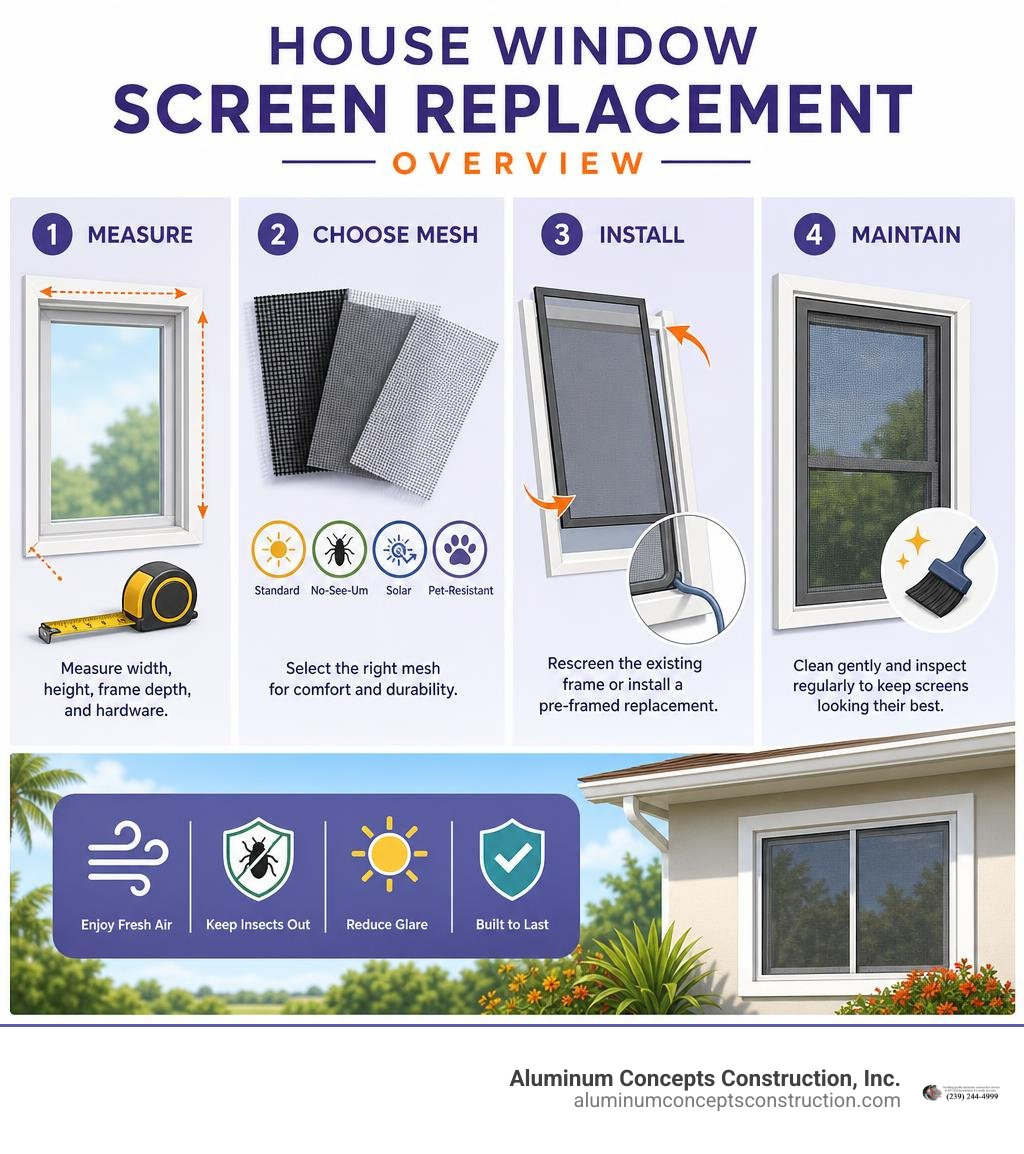
House window screen replacement is usually a straightforward job: remove the old screen, measure the frame or screen pocket carefully, choose mesh that fits your needs, then either rescreen the existing frame or install a custom pre-framed replacement. Standard fiberglass mesh works for most homes, while no-see-um, solar, and pet-resistant mesh solve more specific problems.
Before ordering or cutting anything, measure width, height, frame depth, and the type of hardware that holds the screen in place. A screen that is even slightly too large may bow or fail to seat in its track.
For Fort Myers and Cape Coral homes, the right screen can make fresh air more enjoyable by keeping out insects, reducing glare, and standing up better to everyday wear. This guide walks through materials, measuring, DIY repair, double-hung installation, and when it makes sense to call a professional.
I am Sherman Walker, owner of Aluminum Concepts Construction, Inc., with nearly 25 years in residential construction and home improvement in Southwest Florida. My experience with house window screen replacement and screened outdoor structures helps homeowners choose durable, practical solutions for the local climate.
Understanding Screen Mesh Types and Materials
Choosing the right screen fabric makes a huge difference in airflow, natural lighting, and long-term durability. Depending on sun exposure, tree cover, and whether you live near the water in Pine Island or Bonita Springs, different materials provide specific functional benefits.
- Fiberglass Mesh: The industry baseline for standard residential windows. It is flexible, economical, rustproof, and resists denting. Packaged rolls typically come in charcoal or silver-gray finishes.
- Aluminum Screen Wire: Stiffer than fiberglass, offering strong resistance to sagging. It holds up well against outdoor debris, though it can crease or dent if struck directly.
- Polyester Weave: Heavy-duty synthetic yarn coated in vinyl. Highly resistant to tears, salt-air corrosion, and extreme humidity, making it an excellent choice for coastal environments.
- Stainless Steel: Premium wire mesh that offers unmatched tensile strength and fire resistance. It is often selected for maximum security and areas with high physical impact.
- Copper Wire: A specialized, high-end metal mesh that weathers naturally into a beautiful antique green-brown patina. It delivers exceptional natural resistance to coastal salt air.
| Screen Material | Durability Level | Airflow / Visibility | Best Applied For | Average Cost Factor |
|---|---|---|---|---|
| Fiberglass | Moderate (Up to 5 yrs) | Excellent | Standard bedrooms & living spaces | Low ($) |
| Aluminum | High | Very Good | Sag-resistant standard windows | Moderate ($$) |
| Polyester | Very High | Good | Pet areas & coastal properties | Moderate to High ($$$) |
| Stainless Steel | Maximum | Good | High-traffic, security-sensitive zones | High ($$$$) |
| Copper | Exceptional | Very Good | Historic architecture & salt air | Premium ($$$$$) |
If you are updating larger screened areas around your home, checking out Lanai Screen Replacement Costs and Repair Tips can help you plan your budget across standard window units and expansive patio panels alike.
Standard, No-See-Um, and Privacy Mesh Options
Screen performance largely comes down to the density of the weave:
- Standard Weave (18×16): Standard insect window screen mesh features 18 warp strands by 16 fill strands per square inch (roughly 1.4 x 1.2 mm openings). It blocks common houseflies, mosquitoes, and wasps while offering maximum airflow and transparent outdoor sightlines.
- No-See-Um Mesh (20×20): Coastal Florida living means dealing with tiny biting midges, gnats, and sand fleas. A tighter 20×20 weave provides fine micro-weave filtration that stops these microscopic pests from slipping through while still circulating fresh air.
- Privacy Window Screens: Engineered with specialized tight weaves or micro-coatings that reflect exterior light during daylight hours. This allows you to see clearly outside while preventing neighbors from viewing into ground-floor living areas.
Heavy-Duty Solar and Pet-Resistant Screens
If your windows receive blistering afternoon sun or face high activity from household pets, specialty mesh provides targeted protection:
- Pet-Resistant Screens: Made from heavy-gauge vinyl-coated polyester, this material is significantly stronger than standard fiberglass. It resists scratching, claw punctures, and pushing from energetic dogs and cats. For heavy impact protection against stray sports equipment or golf course fairways, homeowners frequently pair window upgrades with golf ball proof screening.
- Solar Screens: Engineered to absorb and dissipate heat before it reaches your window panes, blocking between 70% and 90% of harmful UV rays. This reduces indoor ambient temperatures, minimizes air conditioning strain, and protects hardwood floors and furniture from fading.
- Heavy-Duty (HD) Fiberglass: Features thicker strands delivering approximately 20% greater tensile strength than standard fiberglass, extending product lifespan without significantly compromising interior light.
Planning Your House Window Screen Replacement: Measuring and Sizing
Accurate measurements prevent frustrating installation delays. Window frames rely on precise track tolerances to hold screens securely against weather and pests.
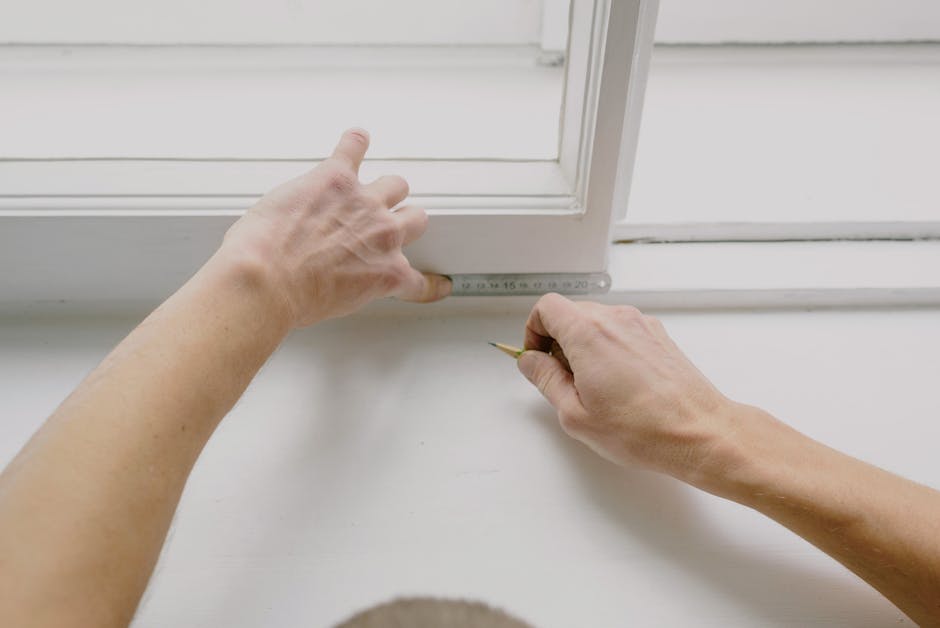
- Measure Width: Use a metal tape measure to record the horizontal opening across the top, middle, and bottom of the window pocket. Use the smallest measurement.
- Measure Height: Measure vertically from the top track channel down to the bottom sill on the left, center, and right sides. Record the shortest measurement.
- Check Frame Depth: Standard window channels typically fit frame profiles measuring 5/16 inch (.3125 in.) or 3/4 inch by 5/16 inch.
- Account for Clearances: When ordering custom rigid screens, standard industry guidance suggests rounding down to the nearest 1/16 inch. Ordering too tight causes frames to bow inward at the center, creating gaps where insects can enter.
Choosing Custom vs. Pre-Framed House Window Screen Replacement
Homeowners can choose between assembling screens on existing aluminum frames or ordering complete pre-framed replacements:
- Extruded Aluminum Frames: Rigid, durable, and traditional. Aluminum frames feature dedicated spline channels where mesh is rolled in and tensioned manually. Larger frames over 48 inches tall often incorporate a horizontal crossbar to prevent the frame sides from pulling inward under screen tension.
- Pre-Framed Units and Flexible Frames: Modern pre-assembled screens use heat-welded mesh attached to spring-steel or extruded aluminum frames. These units pop directly into window pockets without requiring complex hand tools.
- Mounting Hardware: Depending on your window track style, pre-framed units utilize retention hardware such as top corner tension springs, plunger pins (typically spaced 6 inches from corners), pull tabs, or rubber retention bumpers to maintain a snug seal.
Step-by-Step Instructions for Replacing a Window Screen
Rescreening an existing aluminum frame is a straightforward DIY weekend project when you follow proper sequencing.
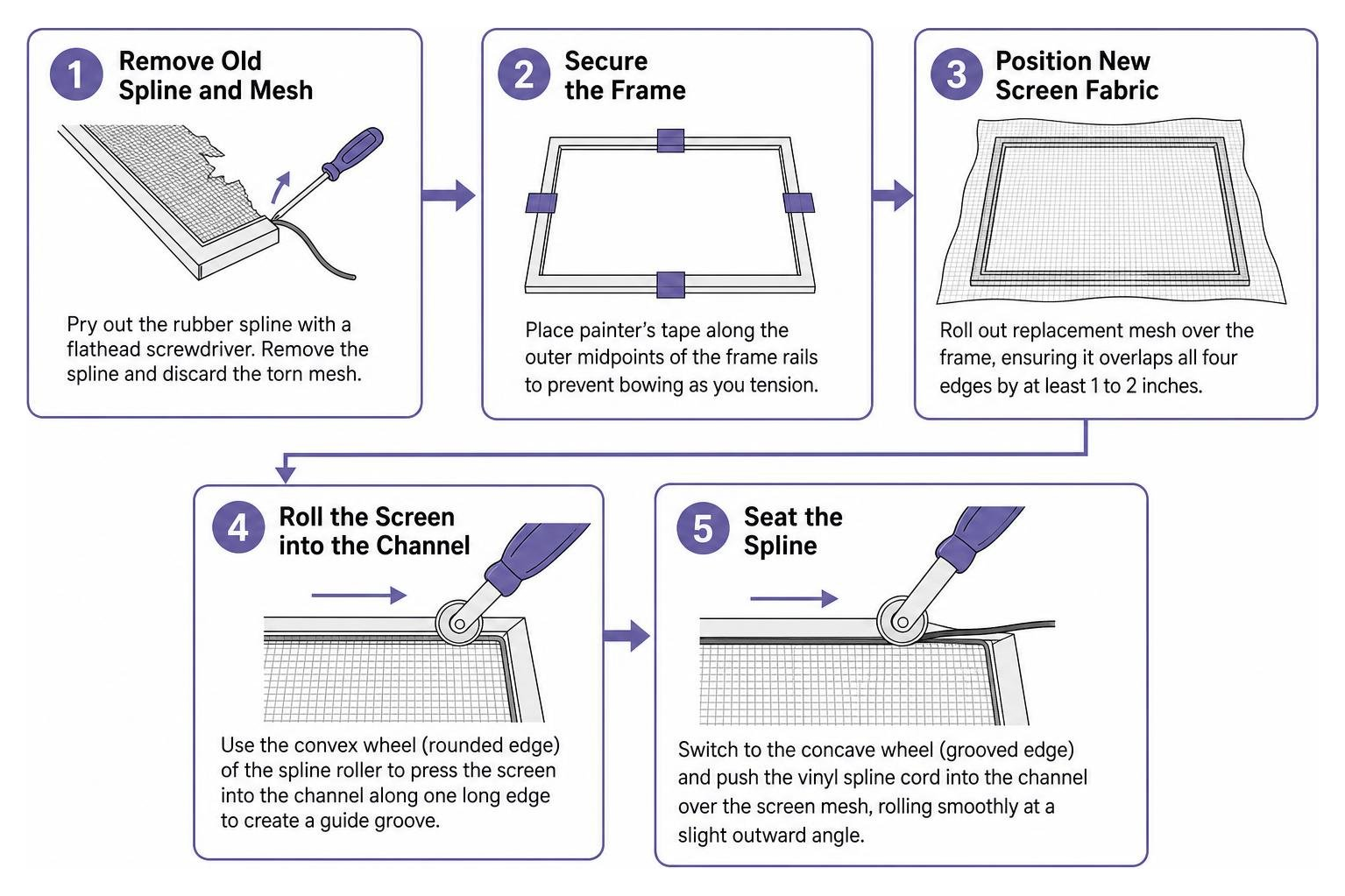
- Remove Old Spline and Mesh: Lay the screen frame flat on a sturdy work surface. Locate the end of the rubber spline cord and gently pry it out using a narrow flathead screwdriver. Pull the entire spline strand free and discard the torn mesh.
- Secure the Frame: Place pieces of painter’s tape along the outer midpoints of the frame rails, anchoring them to your work table. This prevents the frame from bowing inward (hourglassing) as you apply tension.
- Position New Screen Fabric: Roll out replacement mesh over the frame, ensuring it overlaps all four outer edges by at least 1 to 2 inches.
- Roll the Screen into the Channel: Using the convex wheel (rounded edge) of your spline roller, gently press the screen fabric into the frame channel along one long edge to create a guide groove.
- Seat the Spline: Switch to the concave wheel (grooved edge) of your rolling tool. Push the vinyl spline cord into the channel directly over the screen mesh, rolling smoothly at a slight outward angle.
- Apply Even Tension: Move to the adjacent short side, pulling the mesh gently taut with one hand while rolling the spline into place with the other. Repeat on the remaining sides, ensuring the mesh stays flat without over-stretching.
- Trim Excess Mesh: Once the spline is firmly seated all the way around, use a sharp utility knife angled toward the outside of the frame channel to slice away excess screen mesh in one clean stroke.
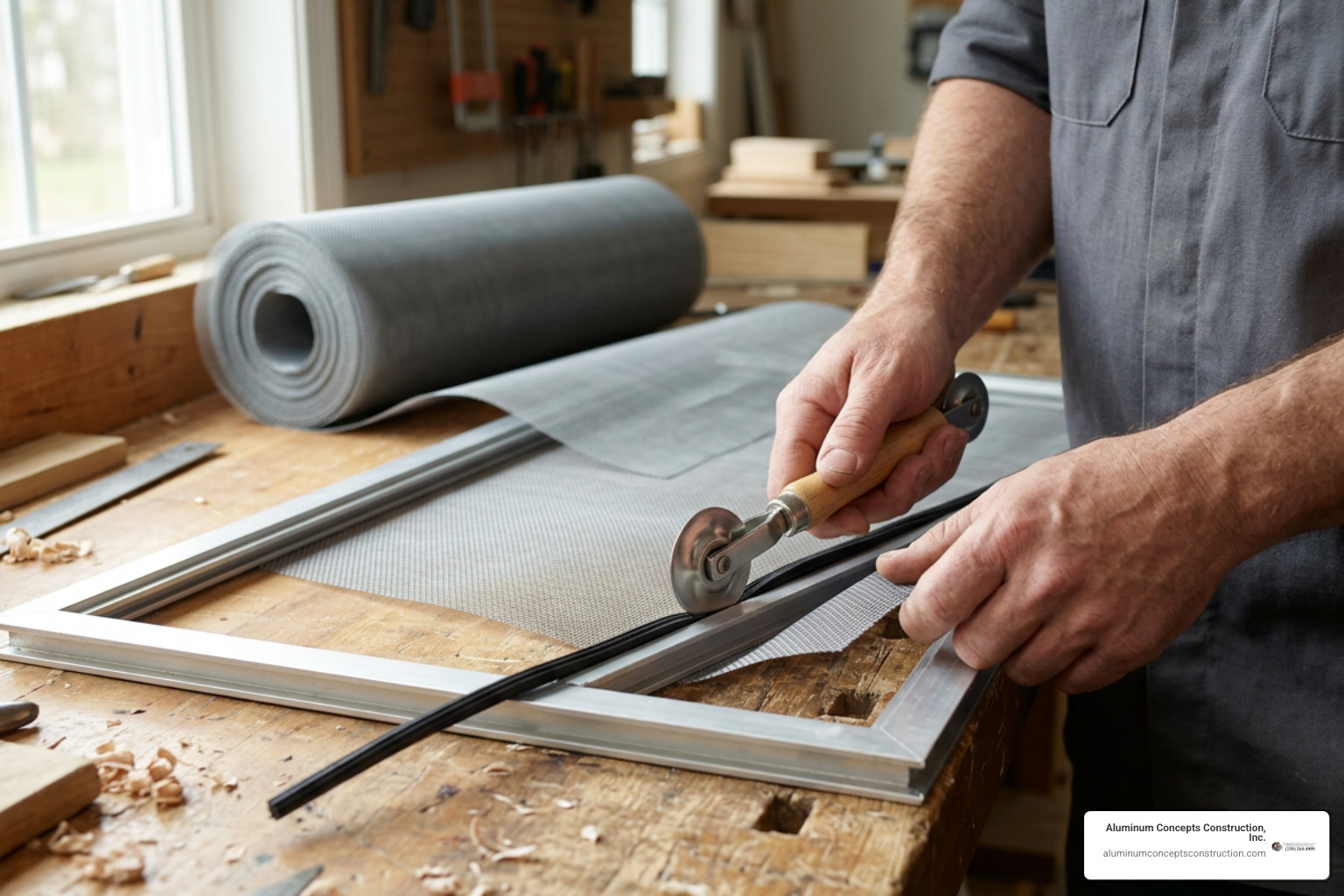
Essential Tools for House Window Screen Replacement
Having the right tools on hand ensures a professional, wrinkle-free finish:
- Dual-Ended Spline Roller: Features a convex wheel for pre-creasing mesh into the groove and a concave wheel for seating the rubber spline without cutting the screen fabric.
- Vinyl Spline Cord: Serrated or smooth vinyl cord that locks the screen into place. Sized according to frame channel width (commonly .125 in., .140 in., or .160 in. diameter).
- Utility Knife with Fresh Blades: Essential for clean, precise edge trimming without tearing adjacent strands.
- Flathead Screwdriver or Awl: Used to gently pry out old, hardened spline.
- Clamps or Painter’s Tape: Stabilizes frame members against pulling forces during spline insertion.
How to Install Screens in Double-Hung Windows
Double-hung windows are among the most popular window designs in residential construction, featuring two independently operating sliding sashes that allow cool air to enter through the bottom while warm air escapes out the top.
To install a replacement screen into a double-hung frame:
- Identify the Hardware: Most double-hung screens utilize leaf springs on one side (or top) and pull tabs on the opposing edge.
- Compress the Springs: Angle the screen into the exterior window screen track, inserting the edge with the leaf springs first.
- Compress and Swing: Push the screen against the channel to compress the leaf springs, allowing the opposite edge to swing flush into the matching window track.
- Release and Lock: Release tension using the pull tabs. The leaf springs will expand against the window pocket, locking the screen firmly against the weatherstripping. For units with plunger pins, simply pull the pins back, seat the frame, and let the spring-loaded pins snap into the pre-drilled track holes.
Screen Maintenance, Minor Repairs, and Longevity
Regular care significantly extends the operational lifespan of residential window screens:
- Tackling Minor Tears: For pinholes or tears smaller than 1 inch, self-adhesive screen patch kits or adhesive mesh tape can temporarily prevent insects from entering. However, for tears exceeding 2 inches, full rescreening is recommended to preserve appearance and structural stability.
- Bi-Annual Cleaning Routine: Clean your window screens at least twice a year. Mix a few drops of mild dishwashing soap in a bucket of warm water. Remove the screens, set them against an exterior wall, and scrub gently using a soft-bristle brush or microfiber cloth to remove pollen, dust, and salt residue.
- Rinse Gently: Rinse thoroughly using a garden hose equipped with a low-pressure spray nozzle. Never use high-pressure washers, which can stretch or puncture screen mesh and warp light aluminum frames.
- Seasonal Storage: If windows remain closed during cooler winter stretches, storing screens flat in an indoor closet or garage keeps them clean and shields them from unnecessary weather wear.
When to Choose DIY vs. Professional Rescreening Services
For standard, single-story residential window units with intact aluminum frames, DIY rescreening provides an economical and rewarding home repair project.
However, professional installation is often the best choice when:
- Aluminum frames are bent, corroded, or missing corner keys.
- You are replacing specialty mesh across dozens of second-story windows.
- You are updating custom architectural entryways, such as adding a dedicated Fort Myers screening front entry for seamless curb appeal.
- You are working on larger structures where wind resistance is essential. In Southwest Florida’s storm climate, knowing how to hurricane proof your screened enclosure requires heavy-duty framing, engineered fasteners, and professional installation.
Frequently Asked Questions About Window Screen Replacement
How do I repair a small hole without replacing the entire screen?
Small punctures under 1 inch can be quickly mended using self-adhesive mesh patch kits or a small dab of clear waterproof silicone adhesive. While functional for keeping bugs out, patches remain visible. If visual clarity and curb appeal are priorities, rescreening the entire frame with new mesh takes under 20 minutes and delivers a clean, seamless finish.
How much does window screen replacement mesh cost?
DIY screen mesh rolls typically cost between $20 and $100 per 100 square feet, depending on whether you choose standard fiberglass, heavy-duty polyester, or high-efficiency solar mesh. Basic replacement mesh rolls can cost under $10 for single-window repairs, while pre-framed custom replacement units generally range from $50 to $160 per window depending on size, frame materials, and hardware specifications.
What spline size should I use for residential window screens?
Spline sizes for residential frames typically range from .125-inch (1/8 in.) to .160-inch (5/32 in.) diameters. The right size depends on the frame channel width and screen mesh thickness:
- Standard fiberglass mesh commonly uses .140-inch spline.
- Thicker pet-resistant or heavy-duty polyester mesh typically requires a smaller .125-inch spline to seat properly without overfilling the channel.
- If your old spline is still intact and flexible, measure its diameter or bring a small sample to your local hardware supplier to ensure an exact match.
Conclusion
Replacing damaged or weathered window screens restores natural airflow, lowers reliance on indoor cooling, and keeps nuisance pests outside where they belong. Whether you choose to roll new fiberglass mesh into existing frames yourself or upgrade to pre-framed solar screens, taking accurate measurements and selecting the proper mesh density ensures lasting comfort across every room.
When your home improvement plans expand beyond standard windows to larger outdoor living spaces, screen rooms, or lanais, our team at Aluminum Concepts Construction, Inc. is here to help. Explore our expert services for Fort Myers Pool Rescreening and custom aluminum structures across Fort Myers, Cape Coral, Sanibel, and Pine Island.
Comments are Disabled