
In Depth Guide to Aluminum vs Other Gutters
Aluminum Gutters: Durable, Low-Maintenance Roof Drainage
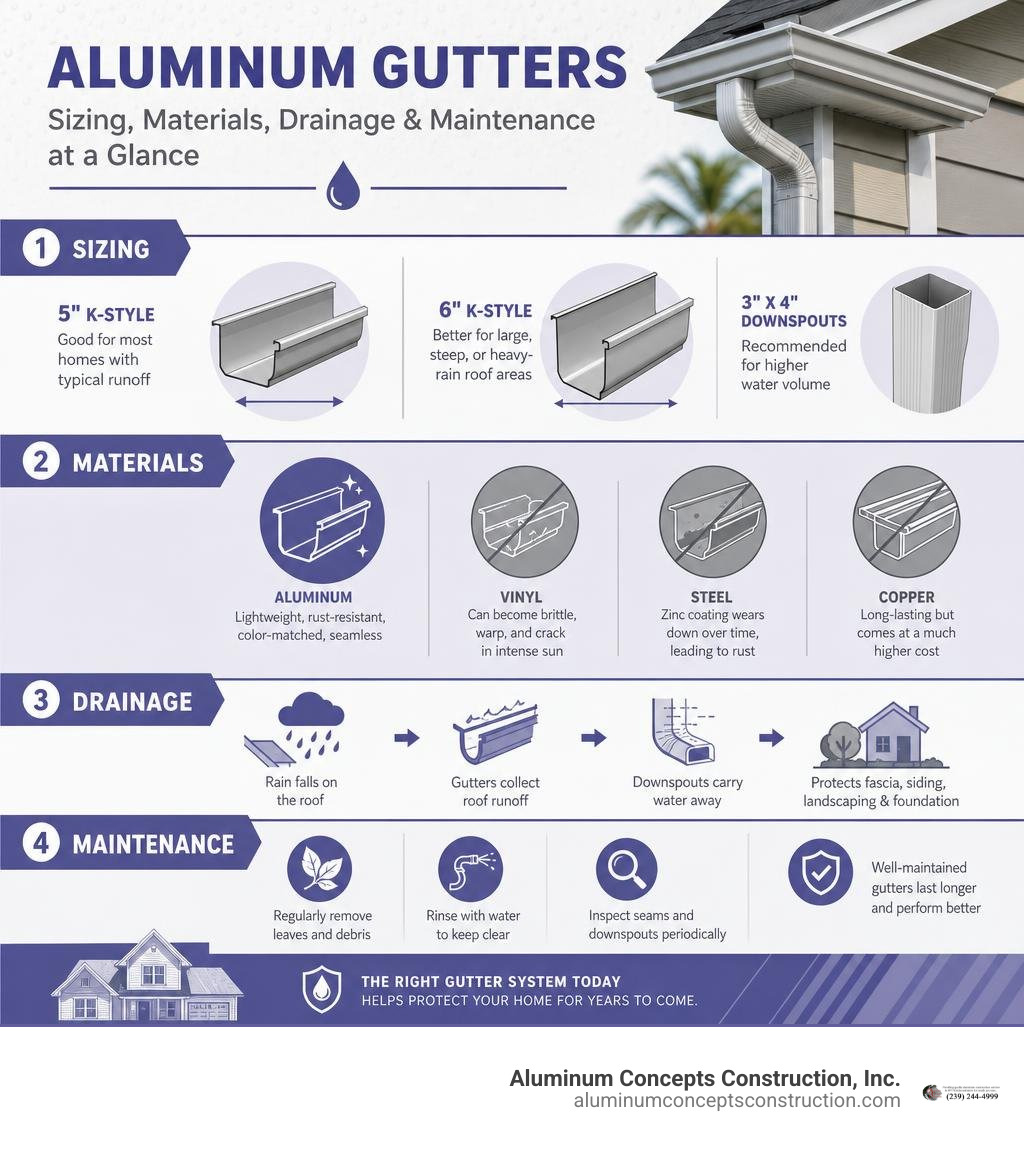
Aluminum gutters are a practical choice for most Florida homes because they are lightweight, rust-resistant, color-matched to exterior trim, and available in seamless runs that reduce leak-prone joints. For most homes, 5-inch K-style gutters handle typical runoff, while 6-inch K-style gutters and larger 3-by-4-inch downspouts are a better fit for large, steep, or heavy-rain roof areas.
Unlike vinyl, aluminum is less likely to become brittle in intense sun. Unlike steel, it will not rust. And while copper can last for decades, aluminum delivers dependable drainage and a clean appearance at a far more approachable price point.
Good gutters do more than catch rain. They help move water away from fascia, siding, landscaping, and the foundation – areas that can suffer when Southwest Florida storms send roof runoff over the edge.
I’m Sherman Walker, owner of Aluminum Concepts Construction, Inc., and I have nearly 25 years of experience helping Southwest Florida homeowners choose and install dependable aluminum gutters and other custom aluminum features. In this guide, I’ll explain how aluminum compares with vinyl, steel, and copper so you can plan a system that fits your home, roofline, and budget.
Why Aluminum Gutters Outperform Vinyl, Steel, and Copper
Choosing the right gutter material involves balancing longevity, weight, structural integrity, and price. When rainwater sheds off steep roofs, your drainage channels must endure heavy hydraulic loads, direct solar exposure, and moisture without sagging or oxidizing. Exploring a practical guide to comparing gutter installation options helps clarify how various materials handle these structural demands over time.
Vinyl gutters are lightweight and inexpensive upfront, but intense heat and ultraviolet radiation cause them to become brittle, warp, and crack over time. When plastic sections degrade, seams pull apart and cause localized foundation erosion. Galvanized steel provides excellent impact resistance against falling debris, yet its protective zinc coating eventually degrades, leading to rust and joint failure.
Copper offers historic visual character and natural antimicrobial properties, developing an attractive patina over decades. However, its high material expense, complex soldering requirements, and substantial weight make it less practical for most standard residential installations.
Aluminum strikes the optimal balance for modern construction. It produces a natural, self-healing oxide film that prevents rust, remains lightweight enough to place minimal strain on fascia boards, and withstands temperature fluctuations through high thermal stability.
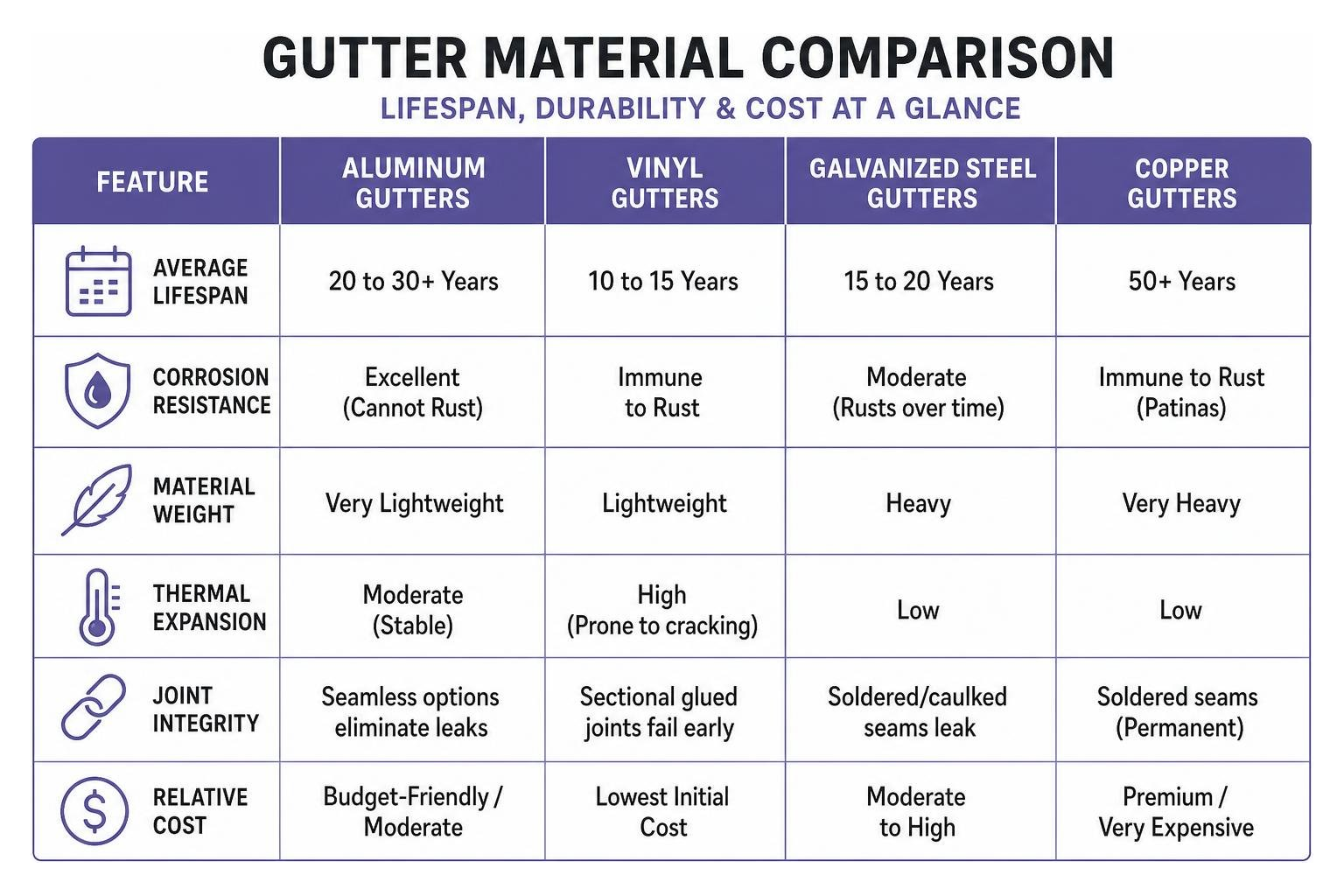
| Feature / Material | Aluminum Gutters | Vinyl Gutters | Galvanized Steel Gutters | Copper Gutters |
|---|---|---|---|---|
| Average Lifespan | 20 to 30+ Years | 10 to 15 Years | 15 to 20 Years | 50+ Years |
| Corrosion Resistance | Excellent (Cannot Rust) | Immune to Rust | Moderate (Rusts over time) | Immune to Rust (Patinas) |
| Material Weight | Very Lightweight | Lightweight | Heavy | Very Heavy |
| Thermal Expansion | Moderate (Stable) | High (Prone to cracking) | Low | Low |
| Joint Integrity | Seamless options eliminate leaks | Sectional glued joints fail early | Soldered/caulked seams leak | Soldered seams (Permanent) |
| Relative Cost | Budget-Friendly / Moderate | Lowest Initial Cost | Moderate to High | Premium / Very Expensive |
System Types, Profiles, and Gauges for Residential Rooflines
Gutter performance depends on pairing the proper system design with the pitch and surface area of your roof. The system must capture high-velocity runoff before it overshoots the trough, carrying the water safely to ground-level drainage routes.
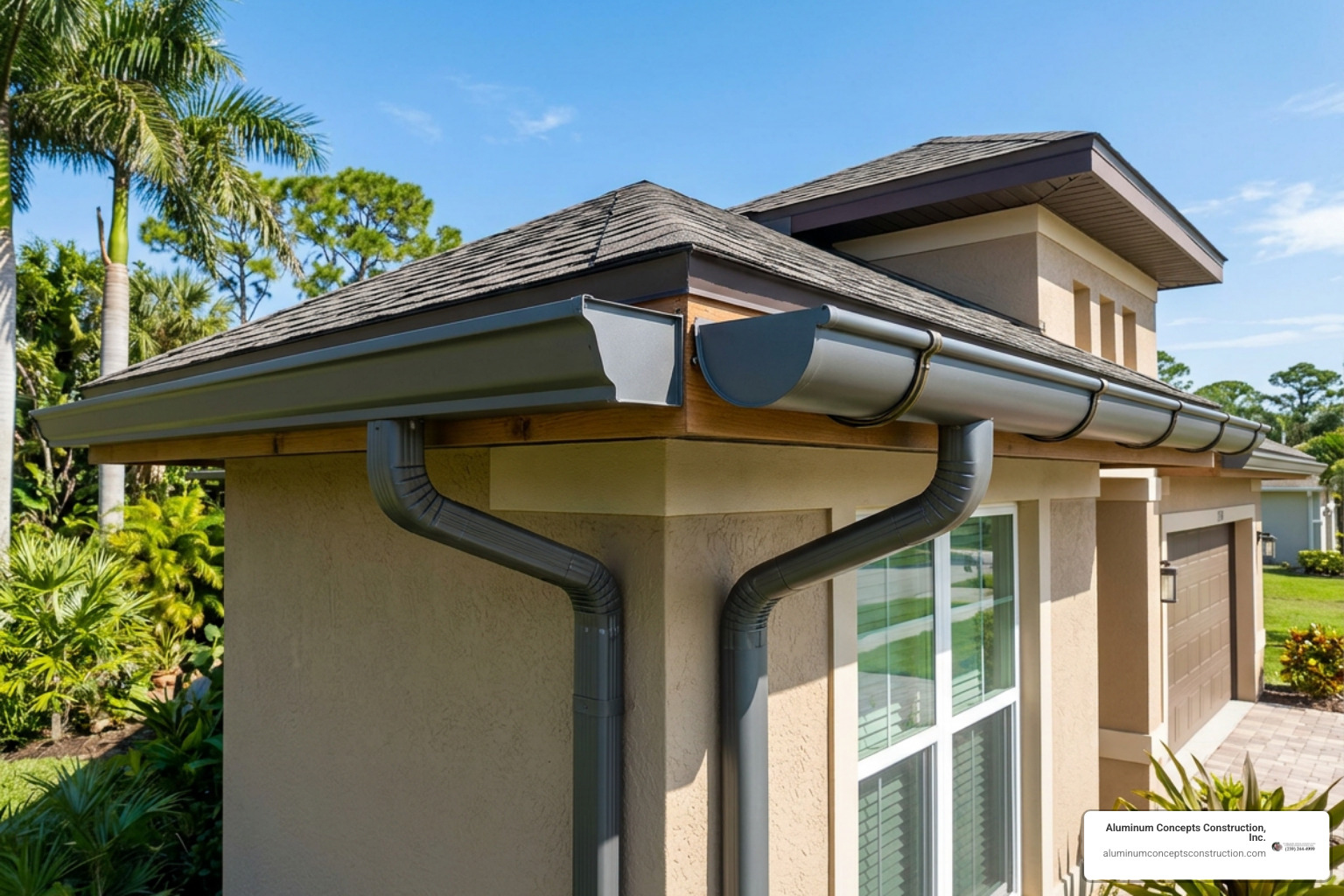
Seamless vs. Sectional Aluminum Gutters
Sectional gutters come in prefabricated pieces—typically 8-foot, 10-foot, or 16-foot sections—assembled using joiners, pop rivets, and sealants. While accessible for DIY work, every joint represents a future leak risk. Over time, thermal movement and water weight fatigue the caulked seams, causing leaks behind the trough that rot structural fascia.
Continuous seamless gutters are fabricated on-site from roll-formed metal coils to fit the exact dimensions of each eaves run. By eliminating mid-run connections, seamless channels provide a clean profile, enhanced water flow, and greater structural strength across long spans. Homeowners exploring our category seamless gutters will find that continuous extrusions reduce maintenance demands while protecting structural foundations.
Sizing, Profiles, and Gauge Thickness Standards
Residential gutters feature two primary architectural profiles:
- K-Style (Ogee): Designed with a flat back that mounts flush against fascia boards and an ornamental curved front resembling crown molding. K-style gutters hold more water volume than round profiles of matching width.
- Half-Round: Semicircular troughs often paired with round downspouts. While favored on classic or historic properties, their shallower profile holds less volume than K-style designs of the same width.
Profile width directly dictates drainage capacity:
- 5-Inch Gutters: Standard for modest roof pitches and smaller surface areas, paired with 2×3-inch downspouts.
- 6-Inch Gutters (6K): Provide expanded volume capacity for steep roof pitches, large roof planes, and intense rainfall, pairing with 3×4-inch downspouts.
Metal gauge (thickness) determines dent resistance and structural longevity:
- .027 Gauge: Standard gauge for light-duty residential sectional applications.
- .032 Gauge: Heavy-duty standard for premium seamless systems, providing dent resistance and rigidity along expansive spans.
- .019 Gauge: Standard thickness for downspout assemblies and drop extensions.
Essential Accessories, Finishes, and System Planning
A dependable gutter system functions as a unified water-shedding assembly. Proper component selection and pitch calculations prevent water ponding, leaks, and overflow.
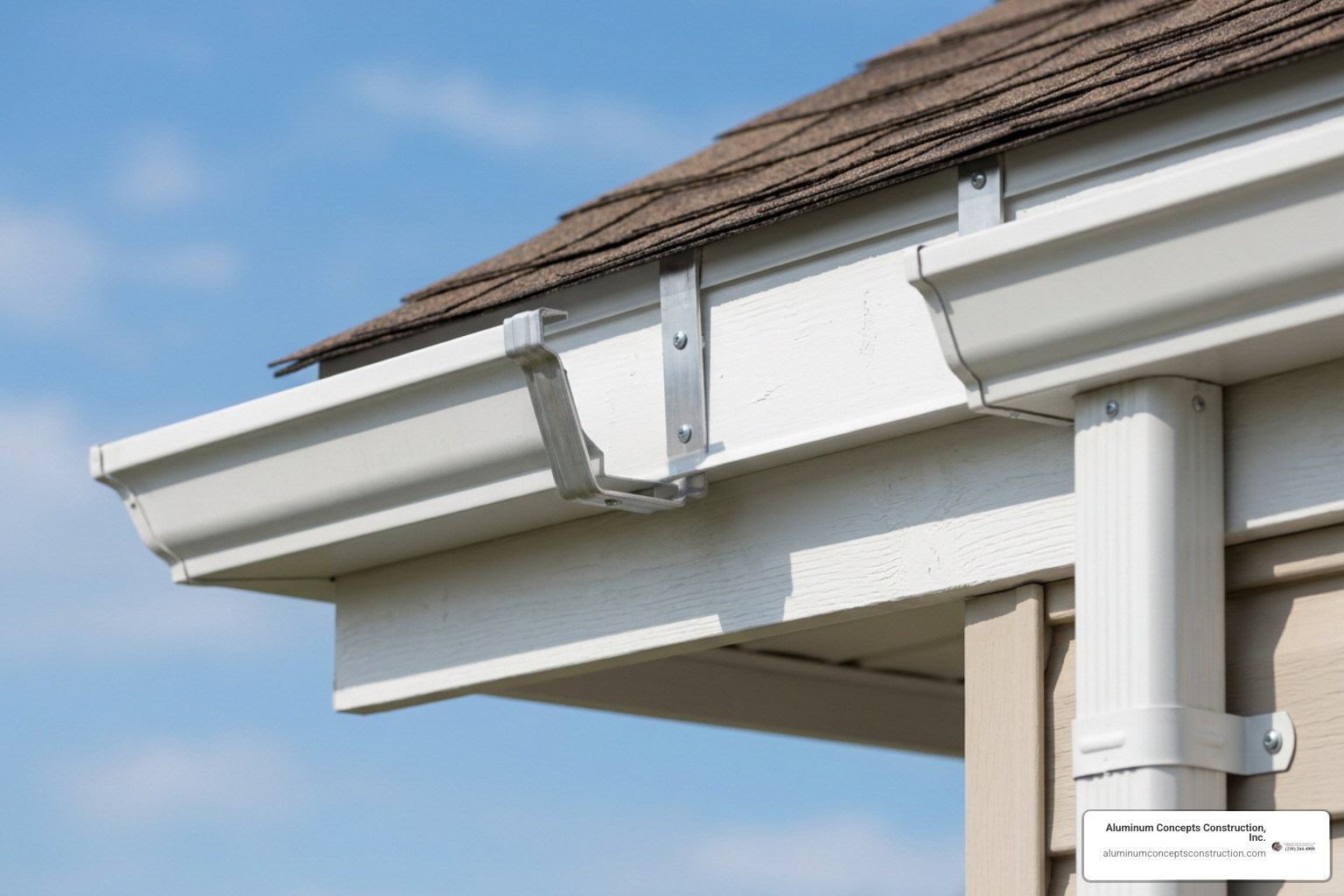
Downspouts, Outlets, and Heavy-Duty Hardware
A complete gutter system relies on precision-matched components:
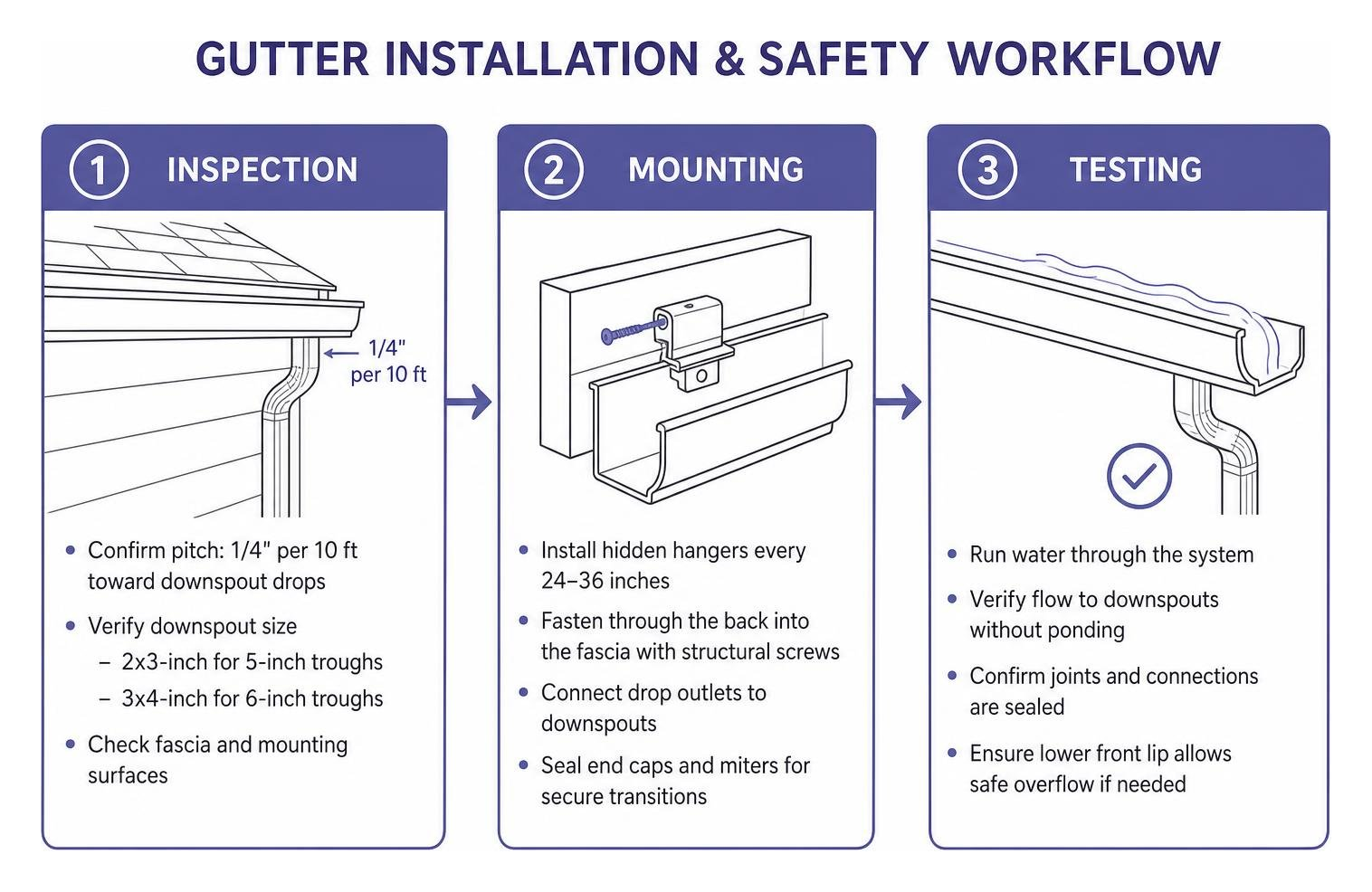
- Downspouts: Match trough capacity—2×3-inch downspouts for 5-inch troughs and 3×4-inch downspouts for 6-inch troughs.
- Drop Outlets: Connect the horizontal gutter run to the vertical downspout, directing runoff into the drainage stack.
- Hidden Hangers: Heavy-duty aluminum brackets snapped inside the gutter trough and fastened directly through the back into the fascia using structural screws. Spaced every 24 to 36 inches, they provide support without visible exterior brackets.
- End Caps and Miters: Left and right end caps close runs, while factory-milled inside and outside corner miters create secure transitions at roof hips and valleys.
Gutter slope is essential. Installers maintain a uniform slope of 1/4 inch per 10 linear feet toward downspout drops, ensuring water exits without ponding.
Custom Sizing, Colors, and Logistics for Aluminum Gutters
Factory-applied finishes protect the metal substrate against chalking, chipping, and environmental wear. Modern components utilize multi-coat baked enamel systems or high-performance Kynar 500 fluoropolymer coatings. Color choices range from traditional Gloss White and Dark Bronze to Musket Brown, Tuxedo Gray, Natural Clay, and Forest Green, integrating cleanly with exterior trim.
Continuous seamless gutters require logistical planning. Standard runs carry an 8-foot minimum length requirement, and because long extrusions cannot ship via standard parcel couriers, contractors use specialized mobile roll-forming machines or flatbed cut-and-drop delivery. Reviewing our tag seamlessgutters highlights how custom lengths eliminate extra field joints and material waste.
Installation Factors, Maintenance, and Common Problem Prevention
Proper installation techniques and seasonal inspections preserve gutter stability and prevent structural moisture damage.
Gutter Guards, Historic Home Codes, and Overflow Prevention
Heavy-duty micro-mesh guards act as a physical barrier against leaves and debris, keeping water flowing smoothly through the trough. For properties near dense foliage, guards reduce seasonal cleaning and lower the need for frequent ladder work.
Quality profiles incorporate a lower front lip design. If downspouts experience severe blockages during torrential downpours, the lower front lip acts as a safety overflow, directing excess water forward onto the lawn rather than backing up against roof eaves, soffits, and interior ceilings.
For designated historic residences, exterior alterations often face strict guidelines. Preserving original eaves architecture requires precise profile selection and custom project renderings to verify that new gutters match historical aesthetics while providing modern moisture protection.
Cost Breakdown and Long-Term Value
Sectional components offer affordable DIY entry points:
- 5-inch x 10-foot sectional troughs: ~$12.98
- 6-inch x 16-foot sectional troughs: ~$39.98
- Matching end caps: ~$1.68 each
- Drop outlets: ~$9.43 each
Custom-extruded seamless systems offer greater value over their multi-decade lifespan. A 5-inch .032 seamless run costs around $4.08 to $4.17 per linear foot for materials, while 6-inch custom .032 extrusions cost approximately $9.99 per linear foot.
Professional installation accounts for bracket mounting, fascia alignment, corner mitering, ladder setup, and existing gutter removal. Learn more in our overview on gutters on a budget and what installation costs per foot. Backed by manufacturer limited lifetime material warranties, heavy-gauge aluminum offers decades of reliable protection.
Frequently Asked Questions About Aluminum Gutter Systems
Can aluminum gutters be painted to match home trim?
Yes. While factory baked-on enamel and Kynar 500 finishes hold their color for decades, aluminum gutters can be painted. Clean the surface thoroughly using a non-residue degreaser, lightly scuff the exterior with a fine abrasive pad to promote mechanical bonding, apply a 100% acrylic metal-bonding exterior primer, and finish with high-grade exterior acrylic latex paint.
How long do aluminum gutters typically last?
Quality aluminum gutters constructed from nominal .032 gauge coil last 20 to 30 years or more with routine maintenance. Because aluminum is naturally rustproof, it easily outperforms thin galvanized metals. Periodic rinsing and clearing debris from hidden hangers ensures maximum longevity.
What is the minimum length for ordering custom seamless aluminum gutters?
Custom seamless gutter extrusions generally carry an 8-foot minimum order length per run. Because continuous runs are extruded to exact fascia measurements without mid-run joints, proper cut list planning ensures smooth on-site delivery and installation.
Conclusion
A well-designed gutter system protects your home’s roofline, prevents siding stains, and guards foundations against soil erosion. By choosing durable .032 gauge seamless aluminum over brittle vinyl or heavy steel, homeowners gain decades of reliable water management with minimal maintenance.
At Aluminum Concepts Construction, Inc., we design, extrude, and install custom exterior drainage systems tailored to regional architecture. Whether you need high-capacity 6-inch K-style troughs, premium micro-mesh guards, or custom-matched finishes, our team provides reliable, long-lasting exterior protection.
Contact us today to explore our fort myers aluminum gutters and schedule your on-site roofline evaluation.
Comments are Disabled